


Laser cladding technology can enhance four major properties of agricultural machinery parts.
Contact Info
- Add:西安市国家民用航天产业基地航天基地299号西安建工科技创业基地十号楼4层, Zip:
- Contact: 段纯
- Tel:17392761868
- Email:gsjgkj@163.com
Other Products


The main techniques for traditional agricultural machinery repair include heat treatment, chromizing, arc spraying, etc., but it is difficult to meet the requirements of wear resistance, corrosion resistance, and pollution-free performance for agricultural machinery. With the continuous development of laser cladding technology, the performance of cladding layers has been improving. In addition to repairing damaged parts, laser cladding technology can also be used to enhance the performance of existing agricultural machinery components.
Compared to high-end manufacturing fields such as industrial machinery, aerospace, and automotive, agricultural machinery manufacturing has always lagged behind. To promote the development of agricultural modernization, it is necessary to strengthen the application of laser cladding technology in the repair and reinforcement of agricultural machinery. Drawing on advanced technologies from other fields can provide direction for the repair and reinforcement of agricultural machinery. Therefore, to improve the reliability of agricultural machinery in complex soil environments, the following aspects can be analyzed:
1. In-situ repair: Agricultural machinery repair involves high intensity and poor working conditions. Many agricultural machinery components are in an overloaded state during long-term use, making them prone to issues such as plastic deformation, wear, cracks, and corrosion. In-situ repair refers to the specific treatment of defective parts to restore their original dimensions. Laser cladding is one of the primary in-situ repair technologies, as repaired parts are less prone to deformation, have fast cooling rates, high precision, and excellent performance, making it widely used in agricultural machinery repair. For example, during the operation of agricultural machinery, gear components are subjected to strong alternating stresses, making them susceptible to issues like burrs, tooth chipping, and deformation. Laser cladding technology can restore damaged gears to their original dimensions. Gears repaired with laser cladding not only function normally but also exhibit significantly improved impact resistance, hardness, and wear resistance.
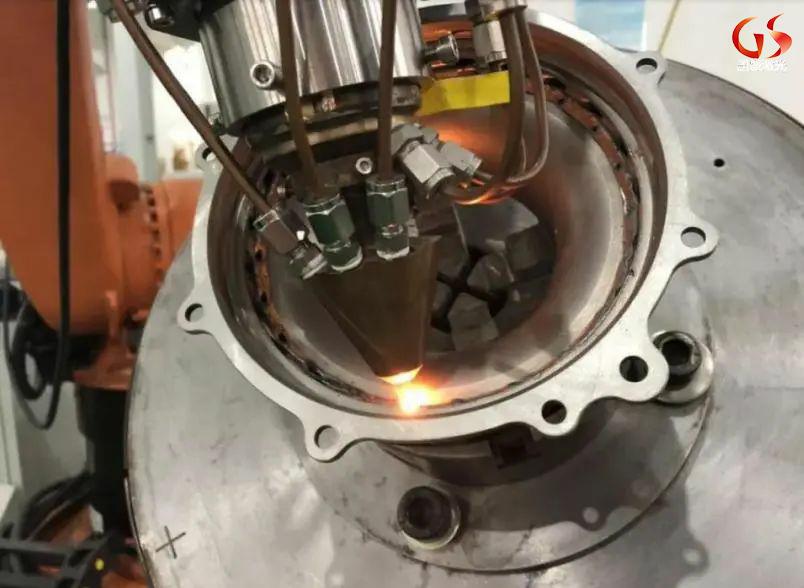
Additionally, shaft components are also among the parts that frequently require repair in agricultural machinery. In addition to enduring alternating stresses, shaft components are affected by friction and wear, with the latter being more significant and a primary cause of damage. The working environment of agricultural machinery is relatively harsh. During long-term rotation, high-hardness sand particles can penetrate the inner shaft, causing wear and deep scratches. These scratches intensify the effect of abrasive particles, further exacerbating the damage process and creating a vicious cycle. Applying laser cladding technology for in-situ repair of bearings can fill scratches and restore the surface morphology of the shaft. The coatings prepared by laser cladding technology are relatively thin, and operators can effectively control the thickness of the cladding layer, ensuring the geometric tolerance and dimensional accuracy of the repaired parts.
2. Improving wear resistance: Wear in agricultural machinery is generally categorized as adhesive wear and abrasive wear, with abrasive wear being the most common. Abrasive wear occurs when the surface of a component rubs against relatively hard abrasive particles. Any direct contact with soil or sand during cultivation can lead to severe wear. There are various cladding materials available to improve wear resistance, with iron-based cladding materials being the most widely used in the agricultural machinery sector.
3. Enhancing corrosion resistance: Agricultural machinery cultivation components often operate in damp and corrosive environments, such as those exposed to pesticides, fertilizers, and organic manure, which accelerates the deterioration of the machinery. The composition of laser cladding powder directly affects the corrosion resistance of the cladding layer. In research and exploration of corrosion resistance, nickel-based self-fluxing alloy powders are the most prominent in the study of laser cladding materials and are widely used in localized areas requiring corrosion-resistant component repair. The addition and control of external field conditions during the cladding process significantly impact the corrosion resistance of the cladding layer.
4. Increasing hardness: Due to the presence of large rocks and plant roots beneath the soil, cultivation components such as rotary tillers and disc harrows may suffer significant impact damage during plowing, which demands higher hardness requirements for agricultural machinery. Under the same laser power and powder feeding conditions, Ni60 alloy cladding layers exhibit higher hardness but more crack defects, while Fe60 alloy has higher hardness in the bonding zone, with a flat overall hardness distribution, forming a good metallurgical bond without obvious defects. Compared to nickel-based alloys, iron-based alloy powders offer ideal comprehensive performance and are more suitable for laser cladding surface treatment of 45 steel. Proper control of the laser cladding process enables rapid melting and solidification of the cladding layer, forming a non-equilibrium, subgranular dendritic eutectic structure. After laser treatment, Si atom solid solution strengthening and fine-grained structural strengthening result in a high-quality, smooth, dense coating with minimal heat-affected zones, significantly improving coating hardness.
Laser cladding with hard phase particles has garnered widespread attention in recent years. Hard phase particles include WC, NbC, TiC, TaC, and VC. The addition of WC particles has a positive effect on improving the microhardness of the substrate. Ni60/WC composite coatings prepared by laser cladding technology exhibit eutectic structural characteristics and high hardness. Hardness-enhanced metal matrix composite coatings, due to their high hardness and certain plastic strain capacity, are widely used on the surfaces of various mechanical components subjected to wear conditions.
| Industry Category | Hardware & Tools/Cutting Power Tools/Drill Bits |
|---|---|
| Product Category | |
| Brand: | 国盛激光 |
| Spec: | |
| Manufacturer: | 西安国盛激光 |
| Origin: | 116101 |


